


STEM toys can be magical or maddening. The same kit that lights one child up can leave another child bored in five minutes. The trick is not to chase the most popular box. It is to match the mechanics of the toy to the way your child thinks, moves, and focuses right now.
We built this guide after watching real kids play. We paid attention to what stayed on the table, what kept getting rebuilt, and what quietly migrated to the closet. We learned that four ingredients matter most: fit, play style, learning goal, and build flow.
Fit is about age range, hand strength, reading level, and attention span. Play style is the preference for open-ended tinkering versus step-by-step builds. Learning goal points you toward motion, circuits, structures, or problem-solving. Build flow is the rhythm of quick wins, clear feedback, and satisfying resets. Miss any of these, and even a great toy will feel wrong.
There are limits to keep in mind. Some kits pack tiny screws that frustrate small hands. Others demand a tablet or long sessions that some kids cannot sit through. Mixed-age homes face real safety tradeoffs with magnets and small parts. These are not deal breakers. They just change what success looks like.
Do this first: watch your child play for ten minutes. Note three things. How long do they stick with one task. Do they follow pictures or jump in and tinker. Do they prefer big motions or fine detail. Jot those down. That quick snapshot will steer you to the right lane below.
We sorted our picks by age and by what the toy actually teaches. Then we tested for clarity of instructions, part tolerances, rebuild value, cleanup time, and how easy it is to fix mistakes without adult rescue. Use this guide as your map, then choose with confidence.
Start here: match the toy to your child, not the hype
Ages 3–5: big motions and zero reading
At this stage, kids respond to chunky gears, snap-fit pieces, and bright patterns. The best toys invite cause-and-effect play with simple wins. Turn a gear and something moves. Stack a piece and it stays put. Look for:
- Large parts that do not require a pinch grip
- Picture-only prompts or no instructions at all
- Builds that finish in 5 to 10 minutes, then reset fast
- Pieces that wipe clean and store in one bin
Red flags: tiny connectors, loose magnets, and kits that expect precise alignment. A bonus is any set that rewards sorting by color or shape, since that builds early math habits.
Ages 5–8: wheels, ramps, and simple machines
Children here can follow picture steps and enjoy light problem-solving. They like motion you can see. Ramps, axles, and linkages make great hooks. Look for:
- Clear diagrams with one change per step
- 15 to 25 minute builds with a visible payoff
- Parts that click audibly so kids know it is right
- Open-ended add-ons after the model works
Watch for frustration if a model fails with one wrong piece. Choose kits that allow easy do-overs and include a few spare connectors. If your child prefers stories, aim for sets that integrate characters or scenery so play continues after the build.
Ages 9–12: multi-step builds and real-world concepts
Older kids can handle layered instructions, test results, and small hardware. They are ready for forces, friction, gear ratios, and basic circuits. Look for:
- Step sequences that build one concept at a time
- Real mechanisms like pulleys, worm drives, or switches
- 30 to 60 minute sessions with clear checkpoints
- Troubleshooting tips that teach how to fix, not just what to do
Edge cases matter here. If your child dislikes manuals, choose modular systems that reward tinkering. If they love detail, kits with measurement, calibration, and data charts will land well. Be mindful of tool use and workspace. A tray and a magnetic parts dish can save a build.
How to choose the right STEM toy for today’s learner
Fit: age, motor skills, reading level, and focus
Start with the age rating, but confirm the real demands. Do a quick pinch test yourself. If the toy needs a tight squeeze or tiny screws, younger kids may tire fast. Scan the manual. Is it text-heavy or picture-led. Match it to your child’s reading comfort. Estimate session length by counting steps and dividing by two. If your child focuses for 15 minutes, look for builds that finish in that window or break cleanly into chunks. Check safety notes if you have toddlers around. Small magnets and button batteries require extra caution.
Action step: before buying, ask yourself where the toy will live. A kit that needs to stay assembled for days will fail if you have only the kitchen table.
Play style: open-ended creativity or guided models
Some kids want freedom to invent. Others love the satisfaction of completing a model that works. Open-ended sets are best when your child narrates stories, mixes sets, and rebuilds constantly. Guided sets win when your child takes pride in following steps and testing a result. Many families do well with hybrids. Start with a guided build to learn a mechanism, then switch to free-building time with the same parts.
Clues to watch: Does your child line up cars by size or immediately build a track. Do they read diagrams in Lego sets or skip ahead. Use those habits to choose a toy that feels natural, not forced.
Learning goals: motion, forces, energy, and persistence
Pick one or two goals, not all of them at once. For motion and simple machines, choose kits with wheels, axles, levers, and gears that show what changes when you swap parts. For energy and circuits, look for clear inputs and outputs. A switch lights a bulb. A motor spins a propeller. For persistence and problem-solving, prefer toys that give feedback without adult help. A model that almost works invites a retry. A kit that fails silently ends the session.
Ask better questions during play. What changed when we moved the fulcrum. How many teeth are on the small gear. Which ramp is faster and why. The right toy makes those questions obvious and fun.
Limitations to note: some electronics sets require apps or a steady internet connection. Noise and flashing lights can overwhelm sensory-sensitive kids. Choose options with volume control or passive builds if that is a concern.
Do this next: set a simple build rule. One clear-up bin, one build tray, and one photo of the finished model. That tiny routine makes it easy to pause and return, which keeps momentum alive.
Quick Comparison
| Product | Best for | Biggest strength | Biggest trade-off |
|---|---|---|---|
| Caferria 110-Piece STEM Building Set for Kids Ages 3–10 | Mixed-age families who want a starter building kit. | Lots of build options without complex steps. | Small parts can frustrate young builders. |
| KAKATIMES Gear Interlocking STEM Building Set for Kids 3–5 | Preschoolers exploring cause and effect with gears. | Chunky, colorful pieces invite quick tinkering. | Limited challenge for older siblings. |
| Engino Newton’s Laws STEM Kit – Build 8 Models (Ages 9+) | Tweens ready to test forces and motion hands-on. | Models make Newton’s laws feel concrete. | Requires patience and careful reading. |
| KAKATIMES STEM Building Blocks — Creative Construction Set for Kids 3–8 | Early builders who like open-ended creations. | Fast, creative builds that spark imagination. | Fewer guided projects for structured learning. |
| Engino Physics Laws STEM Kit for Kids 9+ — Build 6 Models to Explore Inertia, Friction & Circular Motion | Kids who want focused physics experiments. | Clear builds that highlight inertia, friction, and circular motion. | Lower model count and more concept heavy. |
| Learning Resources STEM Explorers Motioneering 56-Piece Motion-Building Set (Ages 5+) | Early grade kids exploring wheels and ramps. | Quick wins with motion-focused pieces. | Limited complexity due to piece count. |
| Engino Mechanics: Levers, Linkages & Structures STEM Kit (Build 16 Models, Ages 9+) | Builders who love levers and linkages. | Many models cover core simple machines. | Builds can be fiddly and time consuming. |
| KASHIAOTE Interlocking Gears STEM Building Set – 180 Pieces, 10 Colors | Big collaborative gear builds at home or class. | Large piece count for moving, colorful creations. | Sorting and storage can be a chore. |
| Engino Pulley Drives STEM Kit for Kids 9+, Build 8 Working Models | Curious kids exploring lifting and ratios. | Working pulley models show real mechanics. | String setup and tension can be tricky. |
| Engino Mechanics: Gears & Worm Drives STEM Kit (Build 12 Models, Ages 9+) | Gear fans who want to try worm drives. | Teaches gear ratios with satisfying results. | Precise alignment is needed to avoid stalls. |
| Collins Obstacle Challenger DIY STEM Robot Kit | First-time robot makers who want a single project. | Satisfying assembly with a moving result. | Replay value is limited after completion. |
| eUda+ DIY Electronic Spin‑the‑Wheel STEM Kit for Kids 8+ (Fire Wheel, Assembly) | Kids curious about simple circuits and lights. | Flashy outcome that rewards careful assembly. | Small components may need adult help. |
1. Caferria 110-Piece STEM Building Set for Kids Ages 3–10
Best Recommended Starter Pick

Looking for a fun way to boost creativity? These 110-piece STEM blocks are safe, colorful, and perfect for kids aged 3–10. Great for hours of imaginative play!
$22.99 on Amazon
Price and availability are accurate as of 03/29/2026 01:53 pm GMT and are subject to change.
If you want a low-stress first STEM set that works for both preschoolers and early graders, this 110-piece block kit fits the bill. The colorful pieces invite tinkering right away, so younger kids can connect and stack without reading. Older kids can stretch into bigger builds and creative challenges. It is a friendly pick for siblings or playdates.
Against our buying guide, it nails fit and play style. Age 3 to 10 is realistic here. Fine-motor demands are gentle, and attention can scale from five-minute builds to long sessions. As an open-ended set, it supports early learning goals like color sorting, counting, symmetry, and simple structures. We like it as a daily creativity booster more than a follow-the-manual project.
The trade-off is guidance and complexity. There are no detailed, multi-step models or advanced concepts baked in. Kids who love instructions or want mechanics and physics may move on quickly. If you care most about open-ended creativity and easy wins, start here. If your 9- or 10-year-old wants more challenge, plan to add a focused physics or motion kit next.
2. KAKATIMES Gear Interlocking STEM Building Set for Kids 3–5
Best for Preschoolers

Spark STEM skills and creativity with colorful, non-toxic blocks. Smooth edges, open-ended builds, and teamwork play keep kids engaged. Curious? See what they can create.
$16.99 on Amazon
Price and availability are accurate as of 03/29/2026 03:29 am GMT and are subject to change.
If you are shopping for a first STEM toy for ages 3 to 5, this gear set fits the sweet spot. The colorful, non-toxic blocks and smooth edges invite curious preschoolers to try, nudge, spin, and rebuild without fear of sharp corners. It works well for short sessions and little hands that are still building coordination.
From our buying guide lens, it nails fit and play style. It is open-ended, so kids can tinker freely, sort by color, and spot patterns. The interlocking gears make motion and cause-and-effect easy to see, which keeps attention without requiring any reading. Teamwork comes naturally here too. One child builds a base while another adds gears and tests the spin.
The trade-off is depth. Older kids looking for complex mechanisms or multi-step models will outgrow the challenge. Builds stay broad and creative rather than precise or technical. That is a plus for preschoolers, but not a long-term path for advanced mechanics.
If you care most about early motor skills, simple motion concepts, and cooperative play, choose this. If your learner is edging into detailed instructions and bigger engineering ideas, step up to a motion or mechanics kit in the next age band.
3. Engino Newton’s Laws STEM Kit – Build 8 Models (Ages 9+)
Best for physics

Spark your child’s curiosity with Engino! Build 8 cool models, explore Newton’s laws, and dive into interactive VR. Perfect for young engineers!
$42.99 on Amazon
Price and availability are accurate as of 03/28/2026 10:58 pm GMT and are subject to change.
If your kid keeps asking why things move the way they do, this kit fits. It’s built for young engineers at 9 and up who like step-by-step builds and want to see motion, forces, and cause-and-effect in action. With eight models to try, there is enough variety for weekend projects without feeling overwhelming.
It nails the 9–12 bracket from our guide: multi-step builds, real-world concepts, and a clear focus on physics and mechanics. The VR component can help connect the builds to what kids see in everyday life, which supports those learning goals of motion, forces, and problem-solving.
Trade-offs are simple. This is a guided experience, so free-form creators may feel boxed in. The VR adds excitement but may take a few minutes to set up. If you want totally screen-free time, you can ignore the VR and still get strong hands-on learning.
If you care most about seeing Newton’s laws come to life through structured builds, pick this. If your child wants open-ended creativity above all else, lean toward a more flexible construction set instead.
4. KAKATIMES STEM Building Blocks — Creative Construction Set for Kids 3–8
Best Great starter pick
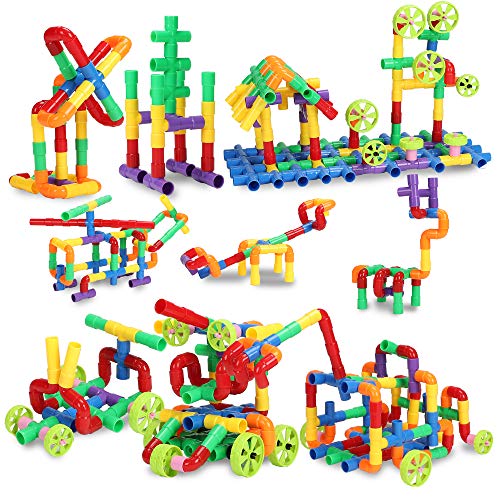
88-piece STEM blocks that click in countless ways for creativity, fine motor skills, and logic. Sturdy, easy to grip—build towers, windmills, animals. Curious? See more.
$18.99 on Amazon
Price and availability are accurate as of 03/29/2026 03:27 pm GMT and are subject to change.
If your learner is in the 3 to 8 window and loves to tinker without a rulebook, this set hits the sweet spot. The click-together pieces are sized for small hands and give instant feedback, so kids can build towers, windmills, or animals without reading anything first. It is a low-frustration entry to STEM play that works for quick after-school sessions or a shared play mat with siblings.
Against our buying guide criteria, it scores on fit and play style: age-appropriate fine-motor demands, zero reading, and open-ended exploration. Kids practice color sorting and patterning, make choices, and see cause and effect as structures get taller or wider. That supports early problem-solving and persistence without turning playtime into homework.
Trade-offs are expected at this level. With 88 pieces, builds top out at medium size, and there are no advanced mechanics or electronics to deepen the challenge for older kids. If your child craves step-by-step projects or real-world physics, plan to add a guided kit from the mechanics category later.
If you care most about quick setup and creative freedom, choose this. If your priority is multi-step models and vocabulary around forces and motion, start here for confidence, then graduate to a physics or simple machines kit.
5. Engino Physics Laws STEM Kit for Kids 9+ — Build 6 Models to Explore Inertia, Friction & Circular Motion
Best Physics starter favorite

Turn physics into play: kids 9+ build 6 working models (yes, a rocket!) and explore motion with a 3D app, quick experiments, and quizzes. Ready to spark their inner engineer?
$37.99 on Amazon
Price and availability are accurate as of 03/29/2026 11:40 am GMT and are subject to change.
If you have a curious 9 to 12 year old who likes following steps and seeing things move, this kit fits. It turns abstract ideas into hands-on play with six models, including a simple rocket, and a 3D app that shows how parts work together. Builds are structured and approachable, so it is a good pick for kids who enjoy a clear start and finish.
It nails several buying-guide boxes for this age. The fit is right for fine-motor skills and reading level, and the play style leans guided with quick experiments and quizzes to check understanding. Learning goals are front and center: motion, forces, friction, and cause and effect. Sessions are short enough for school nights but still feel like real engineering.
Trade-offs to know: it is not a sprawling, open-ended builder, and the six-model scope can cap long-term novelty. The app is helpful, but it does add screen time. If you care most about clear cause-and-effect physics and ready-to-run experiments, choose this. If you want freeform building or a fully screen-free shelf toy, look to broader construction or gears sets instead.
6. Learning Resources STEM Explorers Motioneering 56-Piece Motion-Building Set (Ages 5+)
Best Recommended Starter Pick

Turn playtime into STEM wins—kids build a catapult, trebuchet, and windmill while boosting critical thinking. Includes 8 challenges. A fun gift to spark curiosity.
$18.74 on Amazon
Price and availability are accurate as of 03/29/2026 04:42 am GMT and are subject to change.
For kids just stepping into STEM, this set hits a sweet spot. It is approachable for ages 5 and up, with builds that show motion in action. Families who want obvious cause-and-effect wins will appreciate how a catapult or windmill comes together fast, then invites tinkering. It is a solid pick for after-school play or a simple classroom center.
From our buying guide lens, this lands squarely in Motion and simple machines. The eight included challenges help focus a short session and build persistence without overwhelming new builders. If your goal is to nudge problem-solving and critical thinking in bite-size steps, it does that well.
The trade-off is scope. With 56 pieces, creativity is there but depth is limited compared to big construction ecosystems. Older kids may want more advanced mechanics or multi-hour builds. Also, this is about motion, not electronics or coding, so keep expectations in that lane.
If you care most about hands-on motion demos and fast success for early elementary learners, choose this. If you want long-term complexity and expansive builds, consider a larger system once your child outgrows these challenges.
7. Engino Mechanics: Levers, Linkages & Structures STEM Kit (Build 16 Models, Ages 9+)
Best Great mechanics primer

Turn play into physics: kids build 16 lever models—from seesaws to bridges—with simple guides, experiments, and quizzes. Europe-made, expert-picked. Curious to see more?
$32.29 on Amazon
Price and availability are accurate as of 03/29/2026 09:38 am GMT and are subject to change.
If your kid naturally asks why that seesaw balances or how a bridge holds, this is a strong fit. It suits ages 9 and up who enjoy step-by-step builds and want real concepts behind the play. We like it for weekend projects or short after-school sessions where a clear goal keeps momentum.
It nails our mechanics criteria: motion, forces, and how levers and linkages work together. The simple guides help kids get models moving, while the experiments and quizzes nudge them to test and explain what they see. Europe-made quality gives it a sturdy, classroom-ready feel without getting fussy.
Trade-offs are straightforward. This is a focused physics kit, not an anything-goes creator box. Builds can be multi-step, so expect a little patience and a tidy workspace. If you care most about hands-on understanding of levers and real-world structures, choose this.
If your learner craves wide-open building, consider a more freeform construction set. If they light up when a clear cause-and-effect clicks, lean in here and start with a simple seesaw before tackling the bigger bridge models.
8. KASHIAOTE Interlocking Gears STEM Building Set – 180 Pieces, 10 Colors
Best Open-ended gear play

Snap, spin, and build with 180 colorful gears. Boosts fine motor skills, focus, and STEM curiosity while kids create new designs every time. Great gift for curious builders.
$21.99 on Amazon
Price and availability are accurate as of 03/29/2026 02:40 am GMT and are subject to change.
If your child loves to snap pieces together and make things move, this gear set fits. It is a friendly starter for early builders and a solid pick for siblings or small groups who want to tinker side by side. The 180 pieces and 10 colors invite lots of layouts, from simple chains to playful color patterns.
It nails the open-ended criteria from our guide. There is no reading required, sessions can be short, and the focus is on motion, color, and cause-and-effect. Kids get fine-motor practice every time they press parts together and adjust spacing to keep the spins smooth. We like it for building persistence too. When a design stalls, kids tweak and try again.
Trade-offs are what you would expect from a pure building set. There are fewer guided challenges, and complex, tall structures may wobble unless you plan a wide base and use a flat surface. Cleanup takes a minute unless you keep a bin handy.
If you care most about creative exploration and simple motion, choose this set. If you want step-by-step engineering builds or long, multi-stage projects, look at physics or mechanics kits in our lineup next.
9. Engino Pulley Drives STEM Kit for Kids 9+, Build 8 Working Models
Best Pulley Primer

Hands-on pulley kit for ages 9+: build 8 models, test ideas with fun experiments, and explore in 3D. Great for curious kids who love STEM. Want to see how it works?
Price and availability are accurate as of 03/29/2026 03:41 am GMT and are subject to change.
If your kid is 9 or up and curious about how things lift and move, this focused pulley kit fits. It rewards patience and a steady hand. We like it for builders who can follow multi-step instructions and enjoy seeing cause and effect unfold. Budget-wise, it sits in the sweet spot for a specialty mechanics set rather than a huge all-in-one box.
If cost matters, check our STEM toy value hub for current deals, bundles, and refurbs.
It nails our ages 9–12 criteria: real-world concepts, multi-step builds, and clear experiments that invite tinkering. The 8 working models give structure without feeling repetitive, and the 3D exploration helps kids rotate assemblies and spot where parts go. For play style, it leans guided over freeform, which is great for learners who like a plan and a clear outcome.
There are trade-offs. The parts are small, and careful routing and tensioning take time. The instructions are more technical than picture-led sets for younger kids, so some early co-building from us helps. Space and organization matter too. You will want a tray or bins so pieces do not wander.
If you care most about understanding pulleys in a concrete way and running simple tests, choose this. If your kid prefers open-ended, build-whatever sessions, a broader motion-based set might land better.
10. Engino Mechanics: Gears & Worm Drives STEM Kit (Build 12 Models, Ages 9+)
Best Top Mechanics Pick

Got a curious kid? This award-winning STEM kit teaches gears & worm drives while they build 12 models. Includes a 3D VR app, hands-on experiments, and quizzes. Ages 9+.
Price and availability are accurate as of 03/29/2026 12:41 am GMT and are subject to change.
If your kid is always asking how things turn, lift, and lock in place, this award-winning mechanics set fits right in. It is aimed at ages 9 and up who are ready for multi-step builds and real concepts. We like it for homeschool units or weekend projects where you want hands-on time with clear outcomes. The builds are structured, so it suits kids who enjoy following steps and seeing a working result.
From our buying guide, it nails the physics and mechanics box. Gears and worm drives are the stars here, and the included hands-on experiments and quizzes turn builds into lessons on ratios, torque, and direction control. The 3D VR app is a bonus for visual learners who need to rotate a model and see how parts engage before they try it on the table.
Trade-offs to expect: this is more guided than creative free build, and the instructions reward patient readers. Worm drives trade speed for control, so the motion can feel slow if your child wants instant wow. If you care most about deep understanding of gearing and precise motion, go with this. If your learner prefers open-ended construction, consider a more free-form building kit from the earlier categories first, then step up to this when they are ready.
11. Collins Obstacle Challenger DIY STEM Robot Kit
Best Great first robotics build

Build-and-play STEM fun: a 75-piece kit with tools included, paper/video guides, kid-safe parts, and a bot that scales 9cm obstacles. Curious to see it in action?
Price and availability are accurate as of 03/28/2026 11:16 pm GMT and are subject to change.
If your child loves the idea of building a real moving bot and then stress-testing it on the living room step, this kit hits the sweet spot. It arrives with 75 pieces, the tools you need, and both paper and video guides. That combo lets us choose quick watch-and-build sessions or slow step-by-step reading, which is perfect for families juggling different learning styles.
From our buying guide lens, it nails fit and support. The kid-safe parts lower the anxiety of a first robotics attempt, and the included tools mean no last-minute hunts in the junk drawer. It is a guided, goal-driven project, so kids see motion and outcome fast when the bot scales a 9 cm obstacle. That success loop builds confidence and persistence. Fine-motor practice is built in without being fiddly for the sake of it.
Trade-offs are straightforward. This is not a sprawling, open-ended system. It focuses on a single build that does one impressive thing. You will want a tray or table so the 75 pieces do not wander, and younger builders may need a quick adult check-in to keep parts oriented correctly.
If you care most about a first robot that actually works and shows off right away, choose this. If your learner craves free-form creativity or long-term remixing, look toward open-ended construction sets in our gears or motion categories instead.
12. eUda+ DIY Electronic Spin‑the‑Wheel STEM Kit for Kids 8+ (Fire Wheel, Assembly)
Best Two-level build path

Build a hand-wave prize wheel with real e-components—bright lights, sound, and a clear case. Step-by-step video included. Choose easy assembly (8+) or soldering (12+).
$61.99 on Amazon
Price and availability are accurate as of 03/28/2026 11:43 pm GMT and are subject to change.
If your child lights up when projects come to life, this kit hits the sweet spot. The no-solder path suits beginners around 8 who want a guided win with real parts they can see through the clear case. Older makers can choose the soldering path around 12 for a deeper, more hands-on build. In both cases, the hand-wave activation, bright lights, and sound turn it into a room-stopper that feels like a small science fair booth you can keep on the shelf.
From our buying guide lens, it nails fit and learning goals for DIY electronics: clear cause-and-effect, visible circuits, and a rotating mechanism that rewards careful assembly. The included step-by-step video lowers the frustration curve, so kids can focus on building and basic troubleshooting rather than decoding diagrams.
Trade-offs: this is a project kit, not a bin of open-ended parts. Once built, play centers on the spin-the-wheel experience rather than endless reconfiguring. The sound and flashy effects can be a bit much for sensory-sensitive kids, and the soldering path demands patient hands and an adult nearby.
If you care most about a quick confidence boost, choose the no-solder build and enjoy the showpiece result. If the goal is skill growth and ownership of each connection, the soldering option pays off with real technique your tween can carry to future electronics projects.
FAQ
Buying decisions
Q: How do I pick the right STEM toy for my child’s age and attention span?
A: Start with the age rating, then check fine motor demands, reading level, and build time. Ages 3–5 need chunky parts and picture prompts. Ages 5–8 handle simple machines and 20–30 minute builds. Ages 9–12 do multi-step kits and real-world concepts in 45–60 minute sessions.
Q: Open-ended builders or guided kits, which teaches more?
A: Both teach different skills. Open-ended sets grow creativity, spatial reasoning, and problem framing. Guided kits build perseverance, reading diagrams, and cause-and-effect. Match the mix to your child’s preference and rotate styles to keep motivation high.
Setup and play
Q: How long should a first build session take?
A: Keep the first run short. Aim for 15–20 minutes or one clear win, then stop on a high note. Pre-sort parts, use a tray, and bookmark the next step for an easy re-entry.
Q: My child gets frustrated when a model fails. What should we try?
A: Break the build into small checkpoints and test often. Roll back to the last working subassembly and retry with fewer parts. Mark gear or axle positions with a pen dot. End with a quick success, then return to the challenge later.
If there is one throughline in this guide, it is this: the best STEM toy is the one that matches your child’s stage and style right now. Age ranges are a starting point, but fit comes from fine-motor demands, attention span, and whether your kid lights up at free building or follows steps with pride.
We also saw how categories steer the experience. Early gears and chunky builders spark cause-and-effect. Simple machines add motion and structure. Physics and mechanics kits tie ideas to the real world. Electronics and beginner robots reward patience with that first blink, buzz, or roll.
Your next step is simple. Pick the category that matches your child’s readiness, choose one open-ended set or one guided kit to start, and plan a first build session that fits in a single sitting. Momentum matters more than mastering every feature on day one.
Your quick decision guide
Start with fit, not features
- Ages 3 to 5: reach for chunky gears and interlocking builders. They offer big motions, bright patterns, and zero reading.
- Ages 5 to 8: look for wheels, ramps, and simple machines with picture-led builds. Sessions should be short and satisfying.
- Ages 9 to 12: step into physics and mechanics kits with multi-step builds. Expect real-world concepts like friction, pulleys, and gear ratios.
If your child prefers open-ended play, choose a construction set where any piece can connect to any other. If they crave structure, pick a kit with numbered bags and clear steps. When in doubt, start one level simpler than you think and level up after a win.
Action plan: build a two-toy roadmap
- Ask your child one question: do you want to follow a cool plan or make your own invention?
- Choose one category that fits age and play style.
- Schedule a first build window that matches attention span:
- 10 to 15 minutes for early builders
- 20 to 30 minutes for grades 1 to 3
- 30 to 45 minutes for grades 4 to 6
- Set up success: clear table, small parts tray, and a visible picture of the finished model or an inspiration photo.
- Add a simple challenge for session two. Examples:
- Make the gear train spin slower or faster
- Add a ramp that makes the car roll farther
- Rewire the circuit so the light turns on with a switch
- After two sessions, decide to expand with extra parts, move to a higher-difficulty kit, or switch categories for a fresh spark.
Edge cases to consider
- Sensory seekers or kids who mouth pieces: stick to oversized parts with strong clicky feedback and avoid tiny magnets or button cells.
- Very small play spaces: pick vertical or modular sets and store builds on trays so projects can pause and resume.
- Mixed-age siblings: set ground rules. Older child builds a model first, younger gets open-ended pieces. Rotate roles next time.
- Reading challenges: choose picture-first instructions or kits with video guidance. Pair build steps with verbal cues.
- Short fuses for frustration: start with gear-and-ramp challenges. Immediate motion gives quick wins and keeps curiosity alive.
FAQ: real questions from real families
How long should a build session be?
Aim for a session that ends with success, not fatigue. For preschoolers, 10 to 15 minutes is plenty. Early elementary kids do best at 20 to 30 minutes with a visible milestone, like finishing a wheelbase. Upper elementary kids can stretch to 45 minutes if the build has clear sub-steps. Leave the project mid-momentum by stopping right before the next fun step, so it is easy to restart.
Can we mix sets from different brands?
Yes, with a few checks. Confirm piece compatibility and scale, especially for axles, gears, and hole spacing. If clutch power feels too tight or too loose, keep those systems separate. You can still combine ideas across sets: prototype a mechanism in one system, then rebuild it in the other once the concept works.
What about storage and lost parts?
Small trays and zip bags save sanity. Use a shallow parts tray during builds and a labeled bin per category when storing. For kits with steps, keep sub-assemblies in their own bags between sessions. Snap a quick phone photo at the end of a build to remember wiring paths or gear order. Create a “mystery parts” jar so stray pieces do not stall the next session.
Are magnets and batteries safe for younger kids?
Magnets and button cell batteries require strict supervision and safe storage. For ages under 6, choose systems with fully enclosed magnets or skip magnet sets altogether. Keep all batteries in a locked drawer, and only open battery compartments together. If you are unsure, pick mechanical motion or wind-up power for now and revisit electronics later.
How do we keep interest going after the first model?
Offer a micro-challenge, not a full rebuild. Examples: gear it down to lift a heavier load, add a second support to stop wobble, swap wheel size and test distance, or rewire the switch to change behavior. Celebrate the test loop. Build, try, tweak, and try again. That loop is where problem-solving sticks.
What if my child hates step-by-step instructions?
Shift to open-ended kits and set a theme instead of steps. “Build a drawbridge that opens.” “Make a marble run that takes 10 seconds to finish.” Give one constraint, like height or number of pieces, and let creativity do the rest. Snap photos and ask your child to explain how it works. That reflection is your learning gold.
How do we connect play to real-world concepts without a lecture?
Name the idea at the moment it appears. “See how the small gear makes the big gear turn slowly? That is a gear ratio.” Or, “The ramp is steep, so gravity wins and the car speeds up.” One sentence, then back to play. Later, find a real example outside the toy shelf, like a bike gear or a drawbridge video, and make the connection together.
With a clear sense of fit, a simple two-session plan, and a few guardrails for storage and safety, you are set. Pick your starting category, tee up that first win, and let curiosity pull you forward. The magic is not in owning every set. It is in the steady rhythm of build, test, laugh, and try again.



Leave a Comment