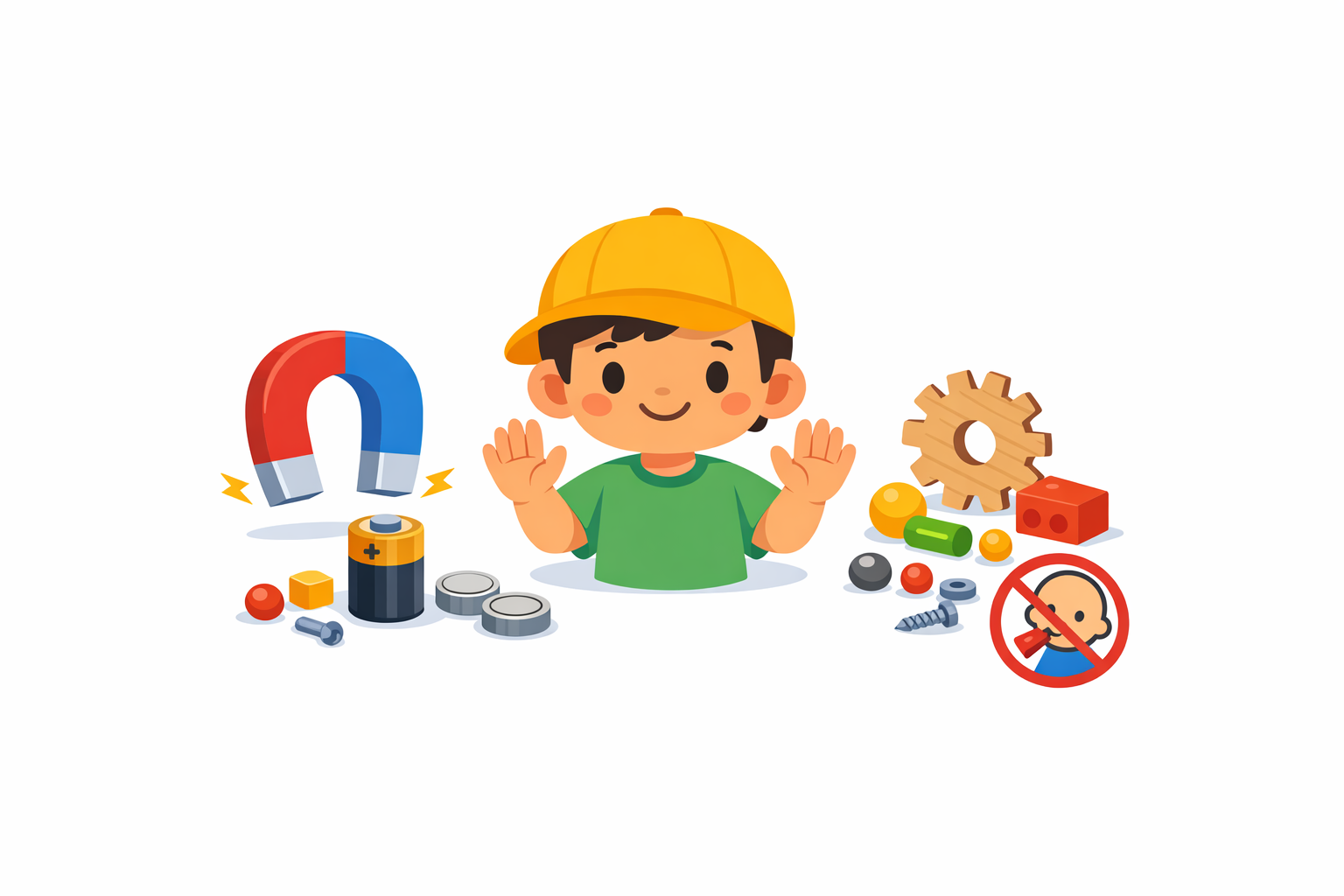

STEM toys light up our kids’ curiosity. They turn questions into hands-on experiments and give us a front row seat to problem solving. But the same parts that make these kits exciting can also introduce real risks. Magnets, batteries, and tiny pieces deserve a closer look before we hit the on switch.
We wrote this guide to help families match the right STEM set to the right age, and to set up play spaces that keep hazards in check. We will translate tech-sounding warnings into plain language. No scare tactics. Just clear steps that fit real homes with real kids.
We will focus on three areas that cause most incidents with STEM kits. Small high-powered magnets. Coin cell and rechargeable batteries. Parts that can lodge in an airway. You will learn how to spot weak points on a toy, run a fast pre-check, and create house rules that actually stick.
This is for parents, grandparents, and caregivers. It also helps makers and teachers who run clubs or classes. We will flag a few edge cases, like mixed-age homes and hand-me-down sets that predate current standards.
Do this first. Grab a cardboard tube from a toilet paper roll. Any piece that fits entirely inside that tube is a choking risk for kids under 3, and often still risky for older toddlers who mouth objects. Keep that quick test handy as you read.
For age-appropriate starter kits, see best STEM toys for ages 2–4.
Why we love STEM kits and where hazards hide
When STEM toys work well, kids build with focus, experiment with cause and effect, and beam when something clicks. The risks are not always obvious though, because the danger often shows up during repair, rough play, or cleanup time, not during the first build.
Magnets that feel magical, but act like metal
- Why they are great: magnetic connectors make builds fast, and they teach polarity and force without a lecture.
- Where risk hides: loose or cracked casings can expose strong neodymium magnets. If two magnets are swallowed, they can attract through tissue and cause internal injury.
- What we check: casing seams and corners for gaps, the number of separate magnet pieces per block, and how firmly magnets are embedded. We also do a gentle drop test on a towel from table height and recheck seams for hairline cracks.
Action tip: run a small strong fridge magnet along the outside of a piece. If the inner magnet shifts or clicks under your fingers, set that piece aside.
Batteries that power discovery, and sometimes trouble
- Why they are great: LEDs, motors, and sensors make builds more satisfying and teach circuits.
- Where risk hides: coin cells can burn tissue if lodged in the esophagus. Rechargeable lithium packs can swell if punctured or overcharged. AA and AAA cells can leak.
- What we check: battery doors with a screw, tool requirement to open, snug foam or gasket around coin cells, and a charge cable that limits overvoltage. We also look for clear polarity markings and a physical on-off switch you can reach without prying anything open.
Action tip: before first use, take a photo of the battery compartment with the batteries installed correctly. Tape it inside the box so any caregiver can match it later.
Small parts that teach precision, and tempt mouths
- Why they are great: tiny gears, bearings, and fasteners teach real engineering.
- Where risk hides: marbles, ball bearings, studs, and caps can block airways. Sets billed for older kids can end up in toddler hands during cleanup.
- What we check: the smallest part diameter against the toilet paper tube test, any detachable caps or decorative domes that can pop off, and the pull strength of cords or tethers attached to small beads or lights.
Action tip: create a bright-colored parts bowl for the smallest pieces. If it is not in the bowl, it is not out. That small routine cuts down on stray parts that younger siblings find.
One-minute fit check for your child, your home, and the toy
Before you buy or unbox, run this 60 second screen. It saves returns and gives you a safer start.
Fit for your child in 20 seconds
- Skill match: can your child follow 3-step instructions without help, or do they still explore by mouthing and banging objects.
- Hand strength: can they pinch and pull connectors firmly, or will they pry with teeth.
- Attention window: will a build last long enough that cleanup can happen before boredom sets in.
Micro-step: ask your child to thread a shoelace through three holes in a card. If that feels hard, avoid kits with many tiny fasteners for now.
Fit for your home in 20 seconds
- Household mix: do you have a crawler or toddler who shares the play space.
- Storage reality: do you have a lidded bin high on a shelf for small parts and coin cells.
- Floor type: magnets and marbles roll far on hardwood and are easier to miss during cleanup.
Edge case: in multilingual homes, warnings may be in one language only. If the instructions are not clear to every caregiver, set a rule that the toy only comes out when a designated adult is present.
Fit for the toy in 20 seconds
- Label check: age grading, magnet warnings, battery type, and clear choking hazard text. No label or vague wording is a red flag.
- Build quality: seams tight, no loose rattling inside, battery door needs a screwdriver, and wires are not pinched at hinges.
- Spare parts: does the set include extra screws or caps. If not, assume lost ones will tempt kids to improvise.
Limitation to note: even good toys can fail after drops or heat. Recheck after hard play, outdoor sessions, or summer car rides. Older or hand-me-down kits may not meet today’s magnet and battery standards, so treat them as higher risk until inspected.
Recommended picks (optional)
A simple starter option

Pocket-size magnet marble run with a push-button launcher—kids design, test, and race anywhere. STEM play that packs smart fun for ages 3+. See how it builds bigger!
Price and availability are accurate as of 10/05/2026 03:02 am GMT and are subject to change.

Good for families just getting into STEM play. We can keep sessions short and guided while we build simple safety habits that stick.
A more advanced option

Build dazzling 3D marble runs with 150 magnetic pieces. Sparks STEM skills and creativity, and clicks with PicassoTiles. Ready to see what they’ll dream up?
$69.99
Price and availability are accurate as of 10/05/2026 05:26 am GMT and are subject to change.
Suited to kids who already follow directions and like multi-step builds. We can introduce tighter magnet and battery rules and let them take a bit more responsibility.
A mixed-age household pick

Build RC vehicles that flip and zip – magnetic pieces + turbo motors, USB-rechargeable power, and extra-safe double-locking design spark STEM creativity. Ready to build?
$54.49 Was $59.99 Save 9%
Price and availability are accurate as of 10/05/2026 08:00 am GMT and are subject to change.
Helps when little siblings may wander through. We keep play at the table, store parts between sessions, and use a quick check-in before and after.
A group or classroom pick

Spark STEM play for ages 3–5 with a 200‑pc magnetic marble run—stable builds, LED marbles, and endless layouts. Safe, sturdy, and easy to tidy. Want to see it in action?
$89.99
Price and availability are accurate as of 10/05/2026 09:27 am GMT and are subject to change.
Works well for small groups where routines matter. We can assign roles, run a short safety brief, and track parts at cleanup so nothing goes missing.
FAQ
Setup and daily use
Q: How often should we inspect magnets, batteries, and small parts?
A: Do a 30 second scan before and after play. Check magnet housings for cracks, gaps, or loose caps. Make sure battery doors are tight and screws are present. Do a deeper check weekly and retire anything damaged.
Q: What is the safest way to store these toys?
A: Use a high, latched bin. Keep coin cells in their packaging or tape over the positives. Remove batteries if a set will sit for weeks. Charge rechargeable packs on a hard surface, away from soft items, and store them in a ventilated container.
Buying and age fit
Q: How can we tell if a STEM toy suits our child right now?
A: Follow the age grade and look for small-parts and magnet warnings. Under 3, avoid any small parts. Under 8, avoid loose small magnets and coin-cell doors without a screw. Prefer captive magnets, larger pieces, and standards like ASTM F963 or EN71 on the box.
Troubleshooting and emergencies
Q: What should we do if we think a magnet or coin cell was swallowed?
A: Stop play and call emergency services or poison control right away. Do not give food or drink and do not induce vomiting. Go to the ER and bring the toy or packaging. Time matters, especially with more than one magnet or a magnet with metal.
We covered a lot of ground, but the heart of it is simple. Magnets, coin cells, and small parts are amazing for learning, yet unforgiving if they go missing or break free. Our job is to match the toy to the child, set up the home so mishaps are unlikely, and know what to do if something goes wrong.
What changes in practice? We gate toys by age and home setup, not only by the box label. We check battery doors before the first play session and again after drops. We sort parts into lidded bins. We keep coin cells and loose magnets out of common areas. We use a short play rule list we can repeat and model.
When we do those small things, the payoff is big. Kids still get the joy of building a bridge that stands, lighting a circuit that works, or steering a bot that moves. We get peace of mind that we shaped the environment to support that curiosity safely.
Your next steps: a 5-minute safety tune-up
Decision recap: what to choose and when
- Under 3 years: Skip loose magnets and any toy with a visible coin cell. Choose large, single-piece blocks and tiles rated for toddlers. If it lights up, the battery door must need a tool to open.
- Ages 3 to 5: Use big magnet tiles or bars where magnets are fully enclosed. Avoid magnetic spheres and marble tracks with small balls. Stick to AA or AAA in screwed battery doors. Skip button cells and lithium packs.
- Ages 6 to 8: You can add beginner circuits with screwed battery doors and basic RC sets with protected chargers. Magnetic marble runs and metal spheres are still a no-go if younger siblings visit or share space.
- Ages 9 to 12: Advanced kits with more parts are fine if you have a storage plan and ground rules. Coin cells are acceptable only if the compartment is locked with a screw and passes your tug test. Introduce safe charging habits.
- Teens: Maker kits with loose cells or soldering can be great with training, a fire-safe charging spot, and a heat-safe workspace. Treat lithium packs with respect and store them in a place you control.
If you have mixed ages or frequent young visitors, default to the youngest child’s needs or create a lockable “big kid” shelf.
Action plan: 6 quick wins
- Do a tube test: if a piece fits inside a toilet paper tube, treat it as a choking hazard for under 3.
- Check every battery door: look for a captive screw, give it a gentle tug, and try to pry it with a fingernail. If it opens, it is not ready for kids.
- Magnet scan: inspect seams on magnet toys. If you see cracks, bulges, or hear rattling, retire the piece.
- Set a charging station: a nonflammable surface, one outlet, cords labeled, no overnight charging, and a clear rule that kids do not move packs while charging.
- Sort and label: dedicate lidded bins for small parts and metal balls, plus a “found parts” jar so we notice strays.
- Register and review: register new toys with the maker for safety notices and add a monthly calendar reminder to check for recalls.
Edge cases to treat differently
- Homes with hearing aids, key fobs, or remotes that use coin cells: keep spares and dead cells in a locking container. Do not leave in junk drawers or purses.
- Kids who mouth objects or have pica, sensory needs, or impulse control challenges: stay with large-format sets, skip magnet spheres and marbles, and store all small parts out of reach and out of sight.
- Pets that chew: keep magnetic and battery-powered toys off the floor after play. Pets can swallow metal balls and batteries too.
- Workshops and makerspaces: if lithium polymer or lithium ion packs are present, create a charge log and an adult-only battery box. Retire any puffed or damaged pack immediately.
Quick answers and resources to bookmark
What if a magnet or battery might be swallowed?
- Treat it as urgent. Do not wait to see if it passes.
- For any suspected magnet ingestion, go to the emergency department now. Multiple magnets or a magnet plus metal can trap tissue.
- For suspected button battery ingestion, call Poison Control at 1-800-222-1222 while you head to care. If the child is over 1 year old and can swallow, Poison Control may advise giving honey while you travel. Do not give honey to children under 1.
- Do not induce vomiting, do not give food or drink unless instructed by medical professionals, and bring the matching battery pack or toy packaging if you have it.
How can we spot a safer magnet set?
- Look for age ratings that align with your child and home. Many strong magnet spheres are intended for ages 14 and up and are not for homes with younger kids.
- Check that magnets are fully enclosed in thick plastic with welded seams. Avoid any piece with hairline cracks, misshapen corners, or surface rust.
- Gently pull at a corner. If the shell flexes or creaks, be cautious.
- Prefer sets that meet recognized toy safety standards and come with clear age guidance and warnings.
Rechargeables vs AA/AAA vs coin cells: which is safer?
- Coin cells are the highest ingestion risk. Avoid them for younger kids unless the door is locked and you can verify it stays shut.
- AA and AAA batteries in a screwed compartment are a solid choice for early grades. Lower ingestion risk and easier to supervise.
- Rechargeable lithium packs are convenient but need rules. Only charge in your designated spot, never leave packs under pillows or on couches, and stop using any pack that looks puffy or smells sweet or chemical.
How often should we re-check toys and storage?
- Do a quick scan after any hard drop or rough play session.
- Run a monthly five-minute check of battery doors, seams on magnet toys, and the bottom of bins for loose parts.
- After playdates, count high-risk parts like metal balls or magnetic beads before putting sets away.
Helpful resources to bookmark
- Poison Control, United States: 1-800-222-1222
- National Battery Ingestion Hotline: 800-498-8666
- Your regional consumer safety authority recall search. In the United States, look up CPSC recall updates and SaferProducts reports.
- Your pediatrician’s nurse line or clinic portal for non-urgent questions.
- A short photo note on your phone of your charging station rules and your “found parts” jar so other caregivers can follow the plan.
We want kids to build bravely and safely. With a few habit tweaks and a calm plan for the what-ifs, we can say yes to the coolest STEM challenges and still sleep well at night.