
If you have a curious two-year-old who loves to pour water from cup to cup, or a three-year-old who cannot stop sorting rocks, you are in the right place. This guide is for parents, caregivers, and teachers who want toys that feel like play but quietly build real skills. We focus on ages 2 to 4 because their hands are small, attention is short, and the best learning happens on the floor.
Here is how to use this guide. Start with our quick picks by age and interest to narrow the field. Then use the decision tips to judge fit for your child and your home. We will talk about safety, materials, cleanup, and what makes a toy get played with again and again. Later, when you browse our specific picks, you will know exactly what to look for.
What matters most at this age is simple. Safety and size of pieces. Open-ended play that invites trying and trying again. Durable parts that survive drops and spills. Clear cause and effect. Toys that build fine-motor strength, early logic, measuring, comparing, sorting, and language. We also test for things that adults care about. Fast setup. Easy storage. Wipe-clean surfaces.
A quick reality check. No toy teaches STEM alone. We set the stage, then follow the child. Some toddlers still mouth everything. Magnets need caution and adult supervision. If you have a baby sibling, visiting cousins, or pets, your safety bar changes. If your child is a thrower, soft or chunky pieces are your friend. And if your home is mostly carpet, tiny wheels may not roll well.
Do this first. Watch your child play for ten minutes without interrupting. Write down three verbs you see. Stack. Pour. Carry. Line up. Those verbs will point you toward the right kind of toy. Then measure one storage bin or shelf you use for toys. Knowing the space will keep sets from taking over your living room.
We evaluate toys with a few concrete checks. Piece size over 1.25 inches in diameter for under age 3. Smooth finishes and sealed magnets. Materials that are wipeable or washable. Parts that fit in one bin or tray. Setup time under two minutes. Clear visual prompts instead of walls of text. And play value that grows from age 2 to 4.
Quick picks by age and interest
For age 2 starters who love to move and stack
Look for chunky builders with big connection points, simple ramps, and cause-and-effect boards. Fewer pieces are better here, but the set should still allow at least three different builds. Prioritize one-skill challenges that repeat. Drop in, roll out, stack up, knock down. Check that pieces are easy to grip with a whole hand and that nothing requires a pincer grasp yet.
For age 3 tinkerers who sort, match, and pretend
Choose sets that add simple rules. Color or shape matching, easy patterns, and first measuring tasks. Think connectors they can click without help, gears that visibly turn, scoops and cups that compare more and less. Include pretend play hooks like vehicles, animals, or food to keep them engaged across longer stretches.
For age 4 problem solvers who ask why
Offer kits with light challenges. Picture cards that show builds to copy, simple coding boards with arrows, balance scales with clear comparisons, and early puzzle logic. Look for modular sets that expand with add-on packs so your four-year-old does not outgrow the core idea. Visual instructions should be step-by-step with big pictures.
For nature lovers and sensory seekers at any age
Pick tools that bring the world closer. Sturdy magnifiers, bug viewers, seed starters, water play trays, and safe droppers. For sensory seekers, add scoops, funnels, and textured blocks. Keep cleanup simple with a tray or mat and a clear routine. If your child is sensitive to noise, avoid battery-powered sounds and choose quiet gears or soft bricks.
For builders who also like art
Blend process art with STEM. Reusable pattern boards, peg mosaics with templates, washable markers paired with stencils, and building sets that accept stickers. Aim for tools that invite design changes without waste. Provide a clipboard or photo routine so they can save their creations without keeping every single piece out.
Choosing STEM toys that actually get played with
Safety and age fit come first
For toddlers, size and construction matter more than any feature. Avoid tiny parts for under 3s. If magnets are involved, they must be fully sealed with no visible seams. Look for compliance notes like ASTM F963 or EN71 on packaging. Do the paper towel tube test for loose parts. If it fits through the tube, it is too small for a mouthing child. Also consider your household. Younger siblings and pets change the rules. If you live near water, keep water play tools for supervised times only.
Action step: Gather three toys you already own. Check for loose caps, chipped edges, or flaking paint. Remove anything that fails before adding new sets.
Open-ended vs guided play
Open-ended toys invite many right answers. Guided toys teach a specific step or sequence. For ages 2 to 4, we aim for a mix. Use open-ended sets to build confidence and repeat skills. Layer in guided cards or simple challenges to stretch focus for short bursts. A good test is this. Can your child play right away without help, then later return with you for a short challenge round.
Durability and materials
Toddlers drop, chew, and stand on things. Favor thick plastic with rounded edges, solid wood with smooth sanding, or food-grade silicone. Fabric parts should be washable. Avoid thin hinges that snap under foot. If a part requires a precise click, try it with wet or sticky hands. If it jams, your child will need you every time, and play will stall.
Manage pieces, storage, and cleanup
The best toy is the one you can put away fast. Aim for sets that live in one bin with a lid. Trays and shallow boxes reduce piece sprawl. Picture labels help kids help. If a set has more than 50 pieces for a two-year-old, plan to rotate half into storage. Keep a handheld vacuum or small brush nearby for sand or seed kits. Write a simple cleanup routine. Pour parts into the tray, tip tray into bin, snap lid, high-five.
Action step: Measure your most used toy shelf. Note the max height and depth. Use that to veto boxes that will never fit.
Noise, power, and mess level
Battery sounds can tip some kids into sensory overload and can also block quiet problem solving. Choose mechanical sounds when you can. If a toy uses water, sand, or beads, pair it with a tray and set a boundary like kitchen table only. For light-up toys, check that they still work with the lights off, so the core play remains even if batteries die.
Inclusivity and your child’s interests
STEM is for every child. Choose sets with diverse characters and stories where possible. Follow your child’s current obsession. Trains, bugs, cooking, or space can all carry STEM ideas. We can always add language and counting to their favorite theme. If a toy theme conflicts with your values, skip it. There is always another path to the same skill.
Budget and longevity
Think in stages rather than single hits. A small starter that connects to a larger family of sets can grow with your child. Look for toys that offer at least three levels of challenge. Free play now, picture prompts later, then open projects after that. If a set only does one trick, it may shine for a week and then collect dust.
Edge case to note: travel and small spaces. If you often play on the go, pick kits with zip pouches and few loose parts. Rolling beads across a car seat feels exciting in the store and impossible in real life.
Quick Comparison
| Product | Best for | Biggest strength | Biggest trade-off |
|---|---|---|---|
| Take-Apart T-Rex Dinosaur Toy with Electric Drill, STEM Building Fun for Kids 3–7 | Little builders who love dinos and tools | Electric drill makes building exciting | Drill noise and many screws need supervision |
| See & Spell Matching Letter Game with Alphabet Cards – Preschool CVC Word Builder for Ages 2–6 | Early letter recognition and CVC word practice | Self-correcting matching supports confidence | Less open-ended than free play sets |
| Hieoby Montessori Stacking Blocks, 30-Piece Sensory STEM Set for Toddlers (Ages 1–4) | Open-ended stacking and sensory exploration | Chunky pieces are easy for small hands | Simpler builds may not hold older kids long |
| GeoSafari Jr. Bindi Irwin Talking Microscope for Kids | First steps into nature and observation | Engaging voice guidance keeps kids curious | Scripted content can limit free exploration |
| Curious 2 Learn 300-Piece STEM Blocks for Creative, Hands-On Play | Big imaginations and large group builds | Huge piece count fuels creativity | Storage and cleanup can be a headache |
| Doctor Jupiter Little Genius Kit – STEM Learning & Science Experiments for Ages 4–6 | Guided experiments and science curiosity | Clear activities make STEM feel doable | Needs adult help and some prep time |
| CENOVE Flower Garden STEM Building Set for Kids 3+ with Storage Box | Fine-motor flower building and patterns | Storage box helps with quick cleanup | Many small pieces to manage |
| TONZE 39-Piece Wooden Kids Tool Set with Tool Bench Box and Apron, Montessori STEM Play for Ages 2–5 | Pretend play with real-feel tools | Sturdy wooden design invites hands-on play | Takes space and setup compared to bins |
| FUNZBO Build-a-Flower Garden Set – STEM Montessori Toy for Ages 2–6 | Cooperative garden builds and color play | Bright mix-and-match parts spark designs | Repetitive for kids who want complex builds |
| COUOMOXA Magnetic Building Sticks – STEM Montessori Set for Ages 3+ | Early magnet builds and 3D thinking | Easy-connect magnets reward quick success | For 3+ only and pieces can go missing |
| Montessori Wooden Lacing Beads and Shape Stacker for Ages 2–5 | Fine-motor lacing and shape sorting | Chunky beads are satisfying to thread | Limited variety compared to big build sets |
| LUDILO 4-Pack Take-Apart Construction Trucks with Electric Drill, STEM Toy for Kids | Vehicle lovers who enjoy take-apart play | Multiple trucks enable shared play | Lots of screws and drill noise to manage |
1. Take-Apart T-Rex Dinosaur Toy with Electric Drill, STEM Building Fun for Kids 3–7
Best dino builder

Build-and-play dinos with movable joints, kid-safe ABS, and a low-speed drill. Sparks STEM skills for ages 3+. Four colorful species—pick a fave and build!
$19.99
Price and availability are accurate as of 10/02/2026 05:21 am GMT and are subject to change.

If your 3 to 4 year old loves dinosaurs and tools, this is a sweet spot pick. It pairs a take-apart T-Rex with a kid-friendly, low-speed drill, so little hands can build with confidence. Once assembled, the movable joints turn it into a sturdy pretend play buddy. It is a natural bridge from chunky toddler toys to real building.
We picked it because it delivers quick wins. Kids line up parts, match screws, and watch their dino come to life. That builds hand strength, patience, and cause-and-effect thinking. The kid-safe ABS holds up to rough play, and the bright, four-species lineup lets you choose your child’s favorite color and style.
There are trade-offs. Small screws like to roll away. Sensitive kids may not love the drill sound. And most kits focus on a single dinosaur, so you choose one, not a whole herd. Plan on some adult help for the first build at age three.
Practical tip: set up a shallow tray or baking sheet as a build zone, and count the screws together before and after. Start each screw with a turn or two by hand, then finish with the drill. Store the dino and fasteners in a zip bag when you are done to keep the set complete for next time.
2. See & Spell Matching Letter Game with Alphabet Cards – Preschool CVC Word Builder for Ages 2–6
Best early literacy pick
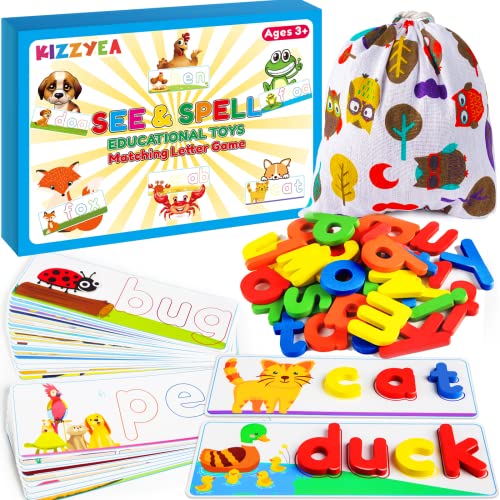
Turn play into reading: 28 double-sided cards and 52 chunky wooden letters build sight words, colors, and fine-motor skills, plus a carry bag for travel-ready fun.
$9.99
Price and availability are accurate as of 10/02/2026 06:54 pm GMT and are subject to change.
Best for toddlers who love puzzles and preschoolers starting to connect letters and sounds. If your child enjoys bringing you letters and asking what they say, this turns that curiosity into simple wins.
We picked it because the tactile, chunky wooden letters invite little hands to grab and place, and the double-sided set of 28 cards gives you plenty of quick rounds. With 52 letters to work with, you can revisit early sight words and color concepts while building fine-motor strength. The carry bag makes it an easy win for car trips and waiting rooms.
There are trade-offs. This is a structured matching game, so it will not replace open-ended builders. There are many pieces, which means cleanup and the risk of a few going walkabout. Very young toddlers may need us to scaffold the steps so it stays fun, not frustrating.
Tip: put only a few cards and a small selection of letters on a tray to start. Celebrate each match, then rotate new cards in. On busy days, toss a handful of letters in the bag and play a five-minute “find the letter” game to keep practice light and happy.
3. Hieoby Montessori Stacking Blocks, 30-Piece Sensory STEM Set for Toddlers (Ages 1–4)
Best for travel
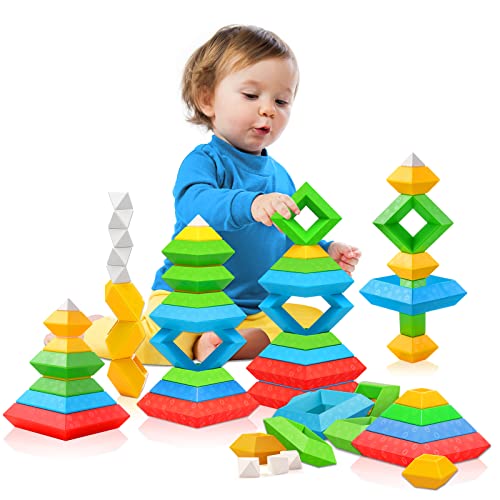
30-piece, 5-color Montessori stackers grow fine-motor + problem-solving skills. Build 60+ designs, then stash in the carry bag—great for travel and tidy play.
$23.99
Price and availability are accurate as of 10/02/2026 11:44 pm GMT and are subject to change.
If your toddler loves to stack, sort, and try again, this set is a sweet spot. The 30 pieces and 5 colors make it easy for ages 2 to 4 to practice color matching, simple patterns, and two-handed coordination without getting overwhelmed.
We picked it because it leans into core early skills without bells and whistles. The pieces support fine-motor work and problem-solving, and the promise of 60 plus design options keeps spatial thinking in the mix. The included carry bag is the clincher. It turns a living room build into grab-and-go play for car rides and tidy storage.
There are trade-offs. With many small pieces, you will want a clear play zone and a quick sweep at the end. It is a stacking set, not a skyscraper kit, so expectations should stay low and steady rather than high and wobbly. Some kids will want new challenges after a while, which is where we come in.
A practical tip: start with color sorting, then move to simple ABAB patterns, and finally try copy-a-build games you model with 3 to 5 pieces. Use a tray or a placemat for a firm base, and make cleanup part of play by racing all pieces into the carry bag before a favorite song ends.
4. GeoSafari Jr. Bindi Irwin Talking Microscope for Kids
Best first microscope

Perfect for curious preschoolers! GeoSafari Jr. Talking Microscope brings science to life with Bindi Irwin’s voice and fun facts. Explore nature up close!
$37.99 Was $59.99 Save 37%
Price and availability are accurate as of 10/02/2026 09:02 pm GMT and are subject to change.
If your toddler picks up every leaf, rock, and feather on a walk, this is a sweet match. We like it best for curious 2 to 4 year olds who ask why and what a lot. The friendly voice of Bindi Irwin and simple facts meet them right where they are, turning quick peeks into little discoveries.
We picked it because it makes early science feel approachable. The talking feature adds context and keeps attention, while the look-closely format nudges kids to slow down and really observe. It is a gentle bridge from casual collecting to noticing patterns, shapes, and textures in the world.
There are trade-offs. This is a toy microscope, so it will not replace a lab-style tool for big kids. Some children may fixate on the talking feature and forget to look. A few minutes of modeling goes a long way.
Practical tip: go on a mini nature hunt, then rotate two or three finds on a tray each week. Ask one simple prompt like what do you notice first or how is this different from the last one. Keep sessions short and let your child do the talking back.
5. Curious 2 Learn 300-Piece STEM Blocks for Creative, Hands-On Play
Best for big builds

300 vibrant blocks spark creativity—build animals, cars, and worlds while boosting STEM skills and fine motor development. Ready to explore?
$20.49
Price and availability are accurate as of 10/02/2026 11:24 am GMT and are subject to change.
If your little one lights up at the idea of making their own creatures, vehicles, and tiny towns, this big box is a win. We like it for toddlers who want room to explore and preschoolers who are ready to plan and tweak their builds. It also shines in homes with siblings since there is plenty to share.
We picked it for the sheer creative runway. Three hundred vibrant blocks give kids enough material to test ideas, change course, and try again. We have seen simple stacks grow into animals, cars, and whole pretend worlds, which naturally builds fine-motor control, spatial sense, and early problem solving.
There are trade-offs. Managing 300 pieces takes intention, and younger toddlers may need close eyes on small parts. Big creations can wobble, which can be frustrating. Start with small goals to keep confidence high and scale up as skills grow.
Practical tip: set a “build zone” with a shallow tray or play mat so pieces stay contained. Offer fast prompts like “Can we make a car using only two colors?” or “Can we build an animal that stands?” Sort pieces by color at cleanup to sneak in early math and make the next session smoother.
6. Doctor Jupiter Little Genius Kit – STEM Learning & Science Experiments for Ages 4–6
Best step-up kit

Curious 4–6-year-old? This kit mixes math & language games with 15 safe, hands-on science experiments plus a durable encyclopedia—screen-free fun. See more.
$26.99 Was $29.99 Save 10%
Price and availability are accurate as of 10/02/2026 04:07 pm GMT and are subject to change.
If your child is right at the edge of four and asking a million why questions, this kit fits. It is also a smart pick for families with siblings where the older child can lead. You get a mix of math and language games with 15 safe, hands-on science experiments, plus a durable encyclopedia for screen-free learning.
We picked it because it blends early literacy with STEM, which is rare in kits for this age. The encyclopedia invites repeat use, and the experiments feel like real doing rather than passive watching. That balance keeps curious preschoolers engaged without a tablet.
There are trade-offs. It skews older than most 2–3-year-olds can handle, and you will need to set up and stay nearby. A few activities can be messy, so plan a surface you can wipe clean. For younger siblings, keep it simple. Use the book for vocabulary and pick the gentlest experiments.
A practical tip: set up a shallow tray as your science zone and do one activity at a time. Make the encyclopedia part of bedtime reading, then choose one experiment to try the next day. Take photos or quick doodles to help your child retell what happened.
7. CENOVE Flower Garden STEM Building Set for Kids 3+ with Storage Box
Best nature-themed builder

Build-a-bouquet fun for little hands. BPA-free, dishwasher-safe pieces mix and match to teach plant parts, boost fine-motor skills, and tidy into the carry box. For ages 3–6.
$23.99
Price and availability are accurate as of 10/02/2026 03:23 pm GMT and are subject to change.
This set is a sweet spot for kids 3 to 4 who love arranging, pretending, and showing you their creations. If your preschooler gravitates to nature play and color sorting, the build-a-bouquet format hits right away. It is also a nice pick for little hands practicing twisting, stacking, and matching.
We chose it because the mix-and-match pieces naturally introduce plant parts while building fine-motor strength. The BPA-free, dishwasher-safe pieces keep cleanup simple, and everything drops into the included carry box, which makes it easy to bring to the kitchen table or stash on a shelf.
The trade-offs are simple. It is labeled 3+, so if your child still mouths toys you will want to wait. There are lots of pieces, which can scatter, and the flower theme may not click with every kid who prefers vehicles or animals.
Try starting with a small selection of parts to avoid overwhelm. Give quick prompts like make a flower with three leaves or build the tallest stem you can. When you wrap up, turn cleanup into a mini lesson by sorting pieces into the box by plant part or color.
8. TONZE 39-Piece Wooden Kids Tool Set with Tool Bench Box and Apron, Montessori STEM Play for Ages 2–5
Best for small spaces

39-pc set with cute apron and a wooden toolbox that flips into a mini workbench. Kids 3+ build, twist, and hammer for STEM play—fine-motor boost, easy-carry. Ready to build?
$26.99
Price and availability are accurate as of 10/02/2026 02:24 pm GMT and are subject to change.
This set is a win for little fixers and builders who love to copy what we do around the house. It is especially great for families in apartments or anyone who needs a tidy setup that travels well. Age-wise, it shines for preschoolers. Two-year-olds can explore with close supervision.
We picked it because the wooden toolbox flips into a small workbench, so kids can build, twist, and gently hammer without taking over the living room. The 39 pieces offer lots of combinations, and the apron invites role play. It is easy to carry to the porch, a playdate, or the grandparents.
Trade-offs are real. The mini bench limits how many kids can work at once, and the tapping can get loud on hard floors. Wood looks lovely but may pick up scuffs over time. Also note the small parts, which makes this feel more like a 3+ set for independent play.
Tip: set it up on a rug or foam mat to soften sound and keep pieces from rolling away. When play is done, have your child help sort parts back into the toolbox. That simple routine builds responsibility and makes the next build faster.
9. FUNZBO Build-a-Flower Garden Set – STEM Montessori Toy for Ages 2–6
Best creative builder

Snap-together flower garden that actually stays put. Safe, BPA-free pieces build fine motor skills and imagination. Bold colors, endless combos, and set sizes for every kid.
$14.98 Was $16.98 Save 12%
Price and availability are accurate as of 10/02/2026 02:29 pm GMT and are subject to change.
This set is perfect for toddlers who love to tinker and arrange. If your child enjoys color play, simple sorting, and snapping pieces together, this garden becomes an instant hit. It works for collaborative play too, since there are plenty of parts to share.
We picked it because the snap-together design actually stays put, which cuts down on toddler frustration. The BPA-free pieces feel sturdy, the colors are bold, and the combinations are practically limitless. It builds fine motor control while letting kids design their own flowers, rows, and patterns.
The trade-off is volume. There are a lot of pieces, so cleanup can take a minute. Kids who prefer clear steps may need prompts to stay engaged. It is also not a great travel toy, since parts can scatter.
Try setting a simple challenge. Ask your child to build a garden with two alternating colors, make a tall flower and a short one, or copy a pattern you lay out. Use a shallow tray or bin so pieces stay contained during play and slide right into storage when you are done.
10. COUOMOXA Magnetic Building Sticks – STEM Montessori Set for Ages 3+
Best 2D to 3D builds

For ages 3–5, magnetic rods & balls click together for easy 2D-to-3D builds. Big, toddler-safe pieces and screen-free play that sparks counting and creativity.
$19.99
Price and availability are accurate as of 10/02/2026 01:11 pm GMT and are subject to change.
If your preschooler loves to build but gets frustrated by tiny bricks, this magnetic rod and ball set is a sweet spot. It is sized for ages 3 to 5, with big pieces that click together and come apart without a struggle. Kids can lay out flat shapes, then stack them into simple towers and arches, which is perfect for short attention spans and quick wins.
We picked it because the click connection invites instant exploration. It naturally teaches spatial reasoning as children move from 2D patterns to 3D forms. The bright colors make it easy to weave in counting, sorting, and simple pattern-making, and the chunky parts are simple to tidy.
There are a few trade-offs. Builds can wobble if kids bump the table, and the balls like to roll. Set play up on a rug or in a low tray to keep everything contained. Start with shape prompts like triangle, square, then try a cube. Count rods as you go and sort colors first to add a little STEM challenge to the fun.
11. Montessori Wooden Lacing Beads and Shape Stacker for Ages 2–5
Best for fine motor

Colorful wooden beads that stack, lace, and match—building fine motor skills and early logic. Pattern cards add playful challenges for curious toddlers.
$16.99
Price and availability are accurate as of 10/02/2026 03:28 am GMT and are subject to change.
If your child loves to sort, stack, and thread things, this set hits the sweet spot. It is great for toddlers who need a calm tabletop activity and for preschoolers who are ready to follow simple patterns. We also like it for mixed ages, since older siblings can model lacing while younger ones stack and match.
We picked it because it blends three skills in one toy. The colorful wooden beads invite free play, then the pattern cards layer on playful challenges that build early logic and sequencing. That mix keeps it fresh as kids move from simple color and shape recognition to copying patterns and inventing their own.
There are trade-offs. Loose pieces can scatter, so a tray or shallow bin helps. Lacing can be tricky at two, which may lead to frustration without a little coaching. Wood and cards can show wear over time, especially with enthusiastic play.
Practical tip: start with stacking and basic color matches. When your child is ready, introduce a single short pattern from the cards. If threading is hard, wrap a tiny bit of tape around the lace end to stiffen it, and offer a muffin tin or small bowls for quick sorting.
12. LUDILO 4-Pack Take-Apart Construction Trucks with Electric Drill, STEM Toy for Kids
Best buildable trucks

Build-it-yourself 4-in-1 trucks: switch between excavator, bulldozer, cement mixer, and dump truck. Pull-back action, real moving parts, and hands-on STEM fun. Ages 3+.”””
$25.99 Was $29.99 Save 13%
Price and availability are accurate as of 10/02/2026 08:50 am GMT and are subject to change.
If your kiddo lights up at the sight of big machines, this 4-in-1 set is a sweet spot. It serves truck lovers who also like to tinker, letting them switch between an excavator, bulldozer, cement mixer, and dump truck. The electric drill adds tool-using excitement while building real hand strength and coordination.
We picked it because the convertible design stretches play from construction to pretend scenes. Pull-back action and moving parts give a big payoff after the build, so kids feel the cause-and-effect of their efforts. Along the way they match parts, tighten screws, and follow simple steps that build patience and sequencing.
There are trade-offs. Small parts mean it is a no-go for kids under 3, and new builders may need a nudge to get started. Pieces can wander, and the pull-back feature works best on smooth floors. It also suits kids who enjoy the process, not just instant-drive trucks.
Practical tip: use a shallow tray to keep screws and parts corralled, and set out only one vehicle’s pieces at a time. Rotate which truck you build each week, then stage a mini construction site with blocks and figurines to extend the story play after the build.
FAQ
Buying decisions
Q: How many pieces are too many for a 2-4 year old?
A: Start small. Aim for 10-30 pieces for solo play. Add more only when your child can clean up without help. Use a rotation box to keep sets fresh and avoid overwhelm.
Q: Are battery-powered STEM toys worth it at this age?
A: They can help with cause-and-effect. Choose ones with clear actions, auto-off, and volume control. Keep spare batteries out of reach. Balance with non-electronic toys that build fine motor skills.
Play and setup
Q: What if my toddler ignores a new STEM toy?
A: Try a 60-second demo, then step back. Offer a simple prompt like “Can we build a bridge for the car?” Reduce pieces on the mat. Pair the toy with a favorite theme or character. Keep sessions short and stop on a win.
Safety and care
Q: How should we clean and store STEM toys for 2-4 year olds?
A: Wipe hard parts with mild soap and water. Avoid soaking wood or electronics. Use mesh bags for washing plastic bricks on gentle. Check often for cracks and loose parts. Store in labeled bins at child height and keep small parts in a lidded box out of reach.
STEM for toddlers and preschoolers is simple, playful, and hands-on. At this age, we are building curiosity, coordination, and language more than content knowledge. The best toys invite kids to stack, sort, connect, compare, and pretend.
Start with a small kit you can set up fast. One open-ended builder and one explore-and-observe tool will cover most days. Match the toy to your child’s current interests and motor skills, not just the age on the box. Keep it safe and sturdy, then let the play grow with them.
Plan for storage before the first unboxing. Fewer pieces out means deeper play and easier cleanup. Model questions, narrate actions, and keep sessions short. Five minutes of shared focus beats twenty of scattered play.
When in doubt, choose toys that do less so your child can do more. The magic is in the conversation, the tinkering, and the little wins that build big confidence.
Your top questions on STEM play at ages 2 to 4
How many pieces are too many?
- Ages 2 to 3 often do best with 20 to 40 pieces in reach.
- Ages 3 to 4 can handle 40 to 80 pieces if storage is clear and cleanup is part of the routine.
- Keep extras stored. Rotate 10 to 20 pieces at a time to refresh interest.
Are electronic toys worth it at this age?
- Keep it simple. Favor clear cause-and-effect lights or sounds over menus and modes.
- Co-play matters more than the feature list. Sit with your child and talk about what happens.
- If screens are in the mix, treat them like a tool for a short, guided session. Think 10 to 15 minutes with you beside them.
How do we prevent choking and other hazards?
- Use a small-parts tester or a cardboard tube. If it fits, it is not for under 3.
- Check for secure batteries and no loose magnets. Inspect pieces after drops.
- Skip water beads and fragile glass items at this age. Supervise any water or outdoor exploration.
My child just dumps or throws. Is that STEM?
- Yes. Dumping, filling, and transporting are real early engineering patterns.
- Offer heavier, chunkier pieces that give feedback, like wooden blocks or large tiles.
- Define a play zone with a tray or mat. Add a safe throwing station with soft balls to meet the need.
- If throwing spikes, reduce the number of pieces and switch to a calmer task like a chunky puzzle.
What storage system actually works for toddlers?
- Shallow bins with picture labels beat giant tubs.
- One-bin rule. Only one set out at a time, then swap.
- Keep a play mat or low tray for builders. Lift the mat to clear the floor fast.
Make your pick and get started
Fast decision recap
- If your child is 2 and still mouthing, choose big, soft, easy-connect pieces and chunky sorters.
- If your child is 3 and building towers, add magnetic tiles, pegboards, and simple pattern games.
- If your child is 4 and asking how things work, try basic gears, ramps, and early coding board activities with no screens.
- Need quiet play in a small space? Puzzles, nesting blocks, and snap-together animals are great.
- Spending time outdoors? Grab scoops, a magnifier, a bucket, and a simple bug viewer.
Week-one setup checklist
- Pick one learning goal, like stacking higher or sorting by color.
- Set out only what you plan to use on a clear mat or tray.
- Sit close and narrate actions. Name shapes, sizes, colors, and positions.
- Ask one open question. What could we try next? or How can we make it stronger?
- Stop on a win. End while interest is high to build anticipation.
- Snap a photo of the build. Use it tomorrow as a prompt to extend the idea.
- Tidy with a simple script. Tiles in the bin, blocks on the shelf.
Edge cases and helpful caveats
- Sensory seekers may throw or crash. Offer weighted blocks, outdoor ramps, and sand or water trays to channel energy.
- Sensory avoiders may prefer soft textures and quiet sets. Keep sounds off and lighting gentle.
- Siblings under 3 need strict small-parts control. Store tiny pieces high and rotate when the toddler naps.
- If your child still mouths often at 3 to 4, stick with jumbo parts and supervised play. Check with your pediatrician if you have concerns.
- In tight spaces or for travel, favor flat kits like tiles, nesting sets, and a roll-up mat.
Simple play prompts for the first week
- Build a bridge wide enough for a toy car. Test, fix, and test again.
- Sort pieces by color, then by shape. Ask which group has more.
- Make a ramp with books and cardboard. Race two objects and compare speeds.
- Create a pattern. Red, red, blue. Can we keep it going?
- Shadow hunt with a flashlight on the wall. Which shapes stack to make a taller shadow?
- Sink or float at the sink with safe items. Predict, test, then try to make a floater sink with added weight.
Pick one small step today. Lay out a tray, invite your child in, and try one prompt. We can always add more pieces later. The habit of curious play starts now.